
ALLRAIL represents independent passenger rail operators, rolling stock investors, and ticketing companies active in competitive rail markets worldwide. Several of our members operate in the United States or are U.S.-owned companies.
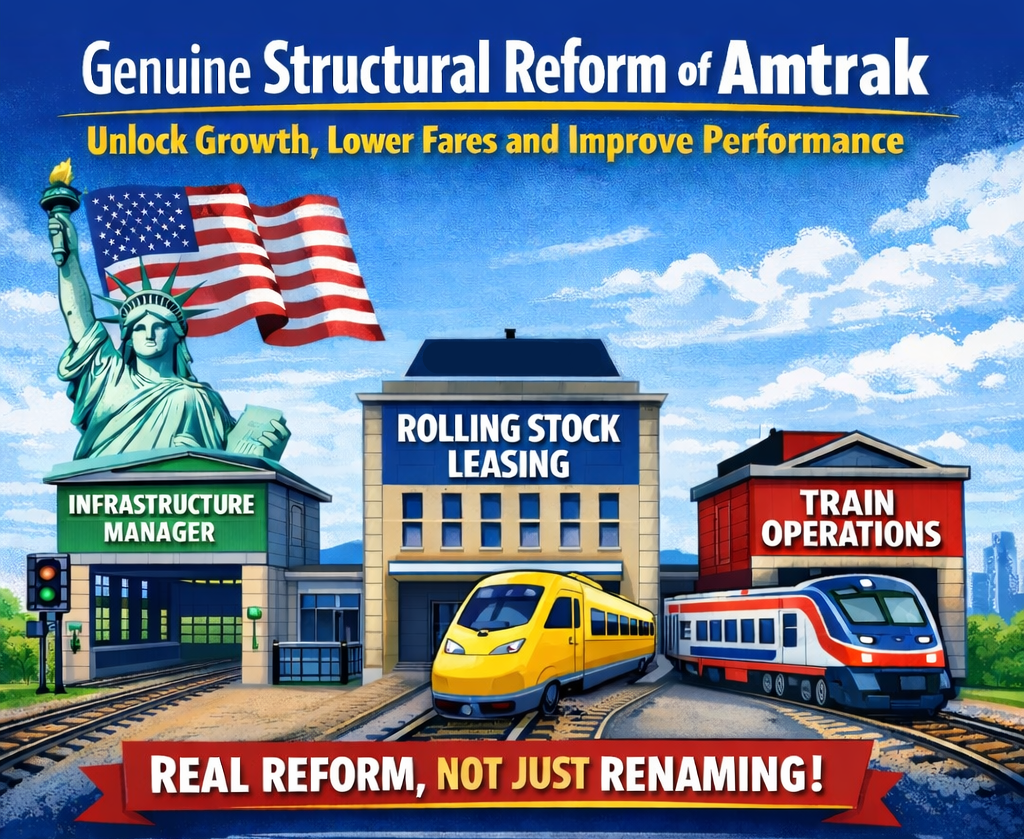
As stakeholders in the future of passenger rail, we welcome reports that the U.S. Department of Transportation (USDOT), through the Federal Railroad Administration (FRA), is exploring structural reform of Amtrak into separate infrastructure, rolling stock and train operations entities.
International evidence is clear: where infrastructure management is genuinely separated from train operations – and markets are opened under transparent, nondiscriminatory rules – passenger numbers grow, fares fall and taxpayers receive better value.
But reform must be real.
True structural reform means separate control, separate management and separate funding for infrastructure, equipment leasing and train operations.
It does not mean renaming internal departments while leaving all three activities under the control of Amtrak Holdings.
If infrastructure, leasing and operations continue to be funded through the same holding company, governed by the same board and with decisions authorized by the same executive leadership, the incentives will remain unchanged.
• Capital allocation, access pricing and commercial strategy would still be centrally determined – limiting competition and deterring private investment.
Without independent governance and independent balance sheets, there is no real separation – only administrative relabeling.
International experience shows what works:
In September 2024, the European Commission confirmed in a formal study that structural reform and the introduction of competition that followed have led to lower fares and higher ridership across multiple EU countries.
• In Italy, following the market entry of the independent high-speed operator Italo in 2012, ridership on the Turin–Salerno corridor quadrupled from roughly 15 million annually to around 60 million. Competition unlocked demand and reduced fares by 40%.
• In the Czech Republic, total infrastructure separation and two new-entrant operators entry led to passenger growth of more than 150% on competitive corridors.
• In Sweden, competitive tendering for regional rail services reduced operating costs by 20–25%, enabling reinvestment into better and more frequent services.
The pattern is consistent: When markets open under clear regulatory guardrails, ridership grows, fares fall and taxpayers receive better value.
The Northeast Corridor opportunity:
The Northeast Corridor – linking Washington DC, New York and Boston – is one of the most commercially promising rail corridors in the world. Yet it remains structurally constrained by a vertically integrated model.
Reform would not weaken the corridor. It would strengthen it.
A genuinely neutral infrastructure manager combined with competitive train operations would:
• Increase service frequency
• Improve asset utilization
• Attract private investment
• Reduce long-term subsidy pressure
This is not an ideological argument. It is an evidence-based one.
A pro-enterprise reform:
The United States has long led the world in competitive markets and private enterprise. Passenger rail should align with that tradition.
Genuine separation of infrastructure, fleet management and train operations is not an end in itself. It is the foundation for transparency, fair access and sustainable growth.
ALLRAIL encourages USDOT, FRA and Congress to pursue reform with clarity and competitive neutrality – ensuring that America’s passenger rail system can reach its full economic and mobility potential.