
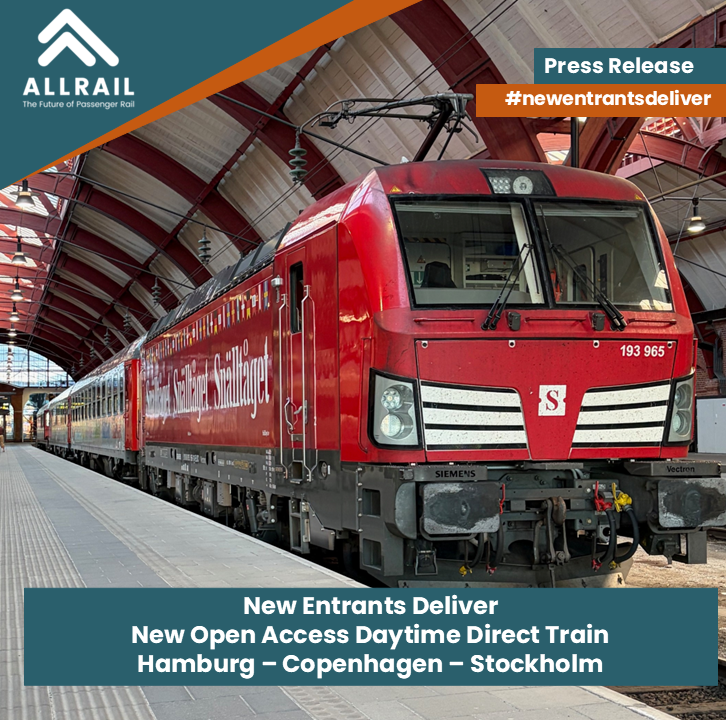
From today, independent rail operator Snälltåget launches a new direct daytime open-access service linking Hamburg, Copenhagen and Stockholm – three major European cities, now connected in one seamless journey.
“We see strong demand for international rail between Sweden, Denmark and Germany. This is why we are introducing a direct daytime service in both directions, from Hamburg to Stockholm and back,” says Marco Andersson, Chief Commercial Officer at Snälltåget.
“Passengers no longer need to change trains in Copenhagen or Malmö — making cross-border rail simpler, faster and more attractive.”
But there is a catch!
Snälltåget’s new commercial service now risks competing not just with other operators — but with the taxpayer. Along the same corridor, the two state-owned incumbent operators Danish State Railways (DSB) and Deutsche Bahn (DB) continue to run a hybrid Public Serivce Obligation (PSO) collaboration, backed by state funding that remains far from transparent.
This raises a simple question: why should taxpayers subsidise services on routes where operators are already willing to compete commercially?
ALLRAIL Secretary General, Nick Brooks, says:
“This is exactly what Europe needs more of: entrepreneurial, passenger-focused rail connecting major cities directly, at affordable prices – without relying on taxpayer support.
But it also exposes a deeper problem.Why are public funds still being used to support parallel services on the same corridor, through arrangements between incumbents like DSB and DB, when independent operators are clearly ready to deliver?
If Europe is serious about a modal shift to rail, the answer is not more subsidies for the incumbent operators – it is more competition.
Fair competition means better choice, lower fares and smarter use of public money. This service shows what is possible when the market is allowed to work.”