
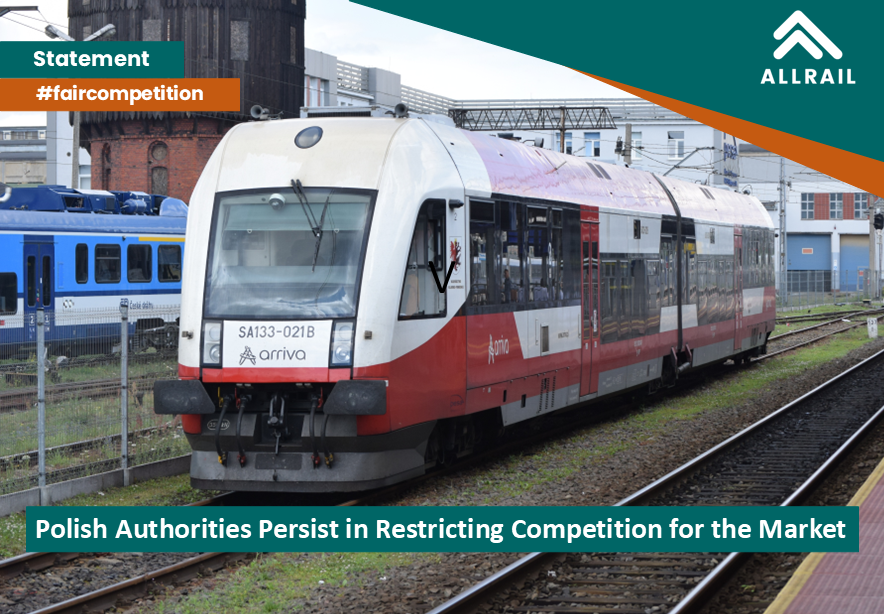
Despite earlier warnings, the Polish authorities are now moving forward with plans to remove competition from regional passenger rail by repealing Article 22a of the Public Transport Act (UPTZ).
This provision requires rail services to be awarded through competitive procedures, ensuring better quality for passengers and more efficient use of public funds. Its removal would mark a clear step backwards.
The claim that Article 22a is only temporary has no legal basis. It appears instead to be a reinterpretation aimed at justifying a return to direct awards.
Permanent reform aligned with EU law
Article 22a was introduced to move away from direct awards and bring Poland in line with EU competition rules under the Fourth Railway Package.
Binding commitment to the European Commission
It entered into force on 3 December 2019 as part of Poland’s obligations under the State aid decision for Przewozy Regionalne, Decision (EU) 2021/1885, including commitments by Poland to open the market for public service obligation rail services.
Clear market-opening objective
Since December 2020, competitive tendering has been the standard approach, with direct awards limited to exceptional cases.
Risk of breaching EU principles
Repealing Article 22a would conflict with the principle of sincere cooperation, which requires Member States to respect both the letter and purpose of EU law.
Possible consequences of non-compliance
There is also precedent for Commission intervention where Member State commitments linked to State aid and competition rules are not properly respected.
In the Ferrovie del Sud Est case, Italy was required to adopt corrective measures following non-compliance with EU State aid rules.
There are also significant legal risks in disregarding commitments made to the European Commission, in particular to its Directorate-General for Competition.
If Poland reverses key commitments linked to its own State aid approval, it could face similar consequences, including renewed investigations, financial recovery measures, or stricter conditions in the future.